

You know your business best. Therefore, you can likely name your direct competitors the second you’re asked. But when it comes to SEO and organic search, there is a much wider net of competition that you may not have even thought about, and knowing who they are and what kind of content they provide can be hugely important to your success in organic search.
Whether it’s on Google, Bing, or any other search engine results page (SERP), your website is constantly competing for real estate. Yes, that space may be taken by a direct competitor or two, depending on their authority and how closely their content aligns with search intent. If the intent is more informational in nature, that search result real estate can also be occupied by blogs and how-to guides; it can be taken by community forums like Reddit and Quora, social profiles, directories, etc. The point is not “how do we beat Reddit?” or “how can I copy what these competitors are doing?” Instead, it’s a question of “how can I use this information to create the type of content that people are looking for when they search specific queries?”
This is key: Understanding the difference between your direct competition and your organic competition, as well as how to use that information to improve organic performance.
What Is the Difference Between Direct and Organic Competition?
Let’s start with the basics. What exactly is the difference between direct competition and organic competition? Say you own a fitness clothing company; your direct competitors are likely going to be other fitness brands that sell the same types of products. When a user types in a search like “best workout leggings,” while they are sure to return a few ecommerce results, that user will also get search results like an article on the “Top 10 Best Workout Leggings of 2026” or a Reddit forum with community members discussing which workout leggings they should buy.

This is where that organic competition comes in. Organic competition includes anyone ranking on that first search results page that isn’t paying to be there, regardless of whether or not they sell the same products you do.
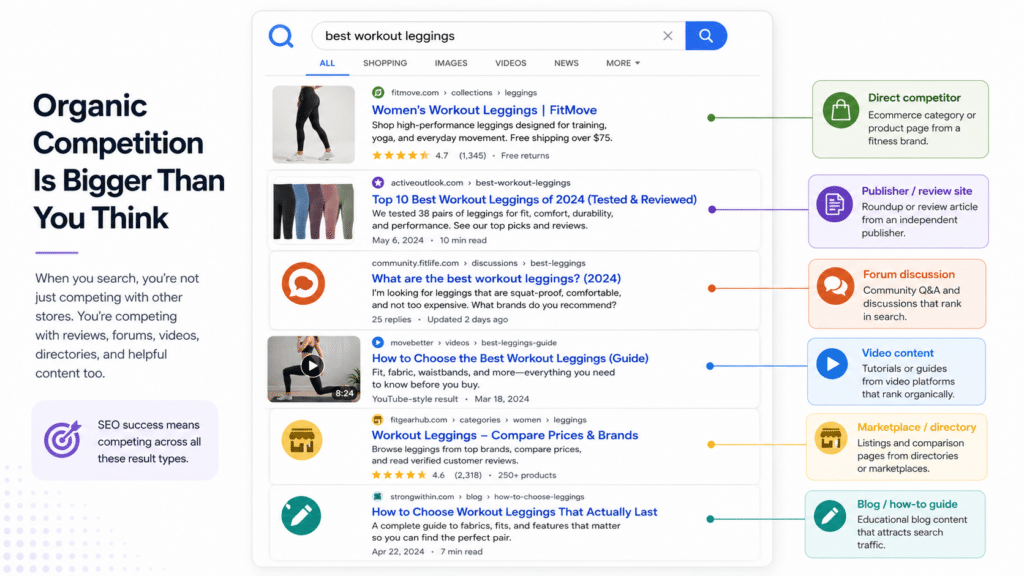
Image Credit: ChatGPT
Why Your Organic Competitors Matter
The search landscape is a different ball game than the business landscape. Having a well-rounded understanding of who is ranking alongside you, or ranking where you want to be, in the SERP is crucial for a number of reasons, including:
- They help you understand search intent: This is a big one. It may feel obvious that your pages would rank for certain queries, but it all depends on the search engines’ understanding of that query and what users are actually looking for, such as product pages, how-to guides, comparisons, or a forum discussion.
- For example: If you sell fresh lemons, you may think “lemon gifts” would make sense to target. However, searching “lemon gifts” populates results for lemon-themed gifts instead of actual fresh lemons. The intent here would not align with what you sell.
- They can reveal content gaps: This goes hand-in-hand with the point above. Understanding what you might be missing can help you cover the topics your site doesn’t address yet. This is also an opportunity to get ahead of your direct competitors that may not be creating those different types of content.
- For example: Say you own a plant nursery, and you want to show off your perennial flower selection, but when you search “perennial flowers” you find that a large chunk of the SERP is taken up by other nurseries with listicles. This presents an opportunity for you to create your own unique list about perennial flowers to compete within that space.
- They help you avoid optimizing a page that likely will not rank: If the SERP is dominated by informational content, pushing an ecommerce page harder won’t move it up the results page because it wouldn’t be aligned with the search intent. Creating informational content to compete with the current top-ranking pages is your best bet.
- For example: You sell training treats for dogs and have resources on how to successfully use these treats to better train dogs. One of the search terms you want to rank for is “How to potty train my dog,” but the search results are either training courses near you or comprehensive guides. Creating your own guide that models what’s ranking and adds your unique expertise on potty-training a dog with a link back to your training treats collection page has a better chance of ranking in this case than a product page.
- They show you that competition can change from query to query: Organic competition tends to be more fluid than your direct business competitors. Depending on the search query, you could be shown a wide range of different page types.
- For example: Searching “organic vegetables” gives you a variety of vegetable delivery companies and farms near you. However, if you tweak that just a little bit to “organic vegetables for heart health,” you get a list of blogs and articles around which vegetables to eat for cardiovascular health that are coming from completely different sites and organizations. If you want to rank for a variety of queries, you need to have content that meets the intent of each of these terms individually.
How to Find Your Organic Competitors
Finding the pages that are ranking for your top queries is as simple as searching those keywords or phrases and seeing who shows up. Here is a good starting point: Start with about 10 searches that matter most to your business and search them individually in Google Search using incognito mode. If you find a competitor that consistently ranks across all 10 searches, they must be doing something right and are worth keeping an eye on.
There is a good chance you will see some of your direct competitors, but you may also find publishers, videos, government sites, guides, or other competition you weren’t expecting. Use this information to understand the intent behind the search. Are the top-ranking pages commercial, transactional, informational, or navigational? Is this search something you can realistically rank for? This can help you inform your SEO strategy moving forward. You don’t want to fly blind when trying to get a leg up on the competition; make sure your next steps are based on clear data.
What to Do With the Information You Find
Once you’ve found your organic competitors and identified opportunities to improve your content, where do you start? This is all about shifting from observation to execution. There are many ways in which you can begin, depending on your unique situation. Ask yourself these questions:
- Could you use a blog to keep up with the competition?
- Are you utilizing your YouTube channel to its full potential by embedding those videos into pages on your site for cross-channel wins?
- Is there an opportunity to create a content cluster that contains supporting content around one valuable topic?
It all depends on why those elements would be useful to your business and whether or not they make sense for your audience. If they do, how exciting is that? You now have the opportunity to reach a whole new pool of potential business through content you may not have even considered before.
Your Search Competition May Not Be What You Expect
Your direct competitors still matter, of course, but they don’t tell the whole story. Understanding the search results page in relation to the keywords that matter most to your business is key to creating content that can compete with both direct competitors and your organic competition. The goal here is to serve a wide audience without copying the competition.
Go out there and create fresh content that speaks to what users are looking for, while demonstrating E-E-A-T. That may mean you need to add some informational content to your site through blogs or how-to guides, or maybe you need to beef up your product pages with FAQs in order to increase your chances of citation in AI Overviews. Whatever the case may be, use your SEO competitors as a way to brainstorm new ideas and create a site that can become a trusted source within your niche.