

If you’ve been working in search engine optimization (SEO) for some time now, you probably remember the days of creating separate pages for each high-volume keyword you wanted to rank for in hopes of being rewarded with a top spot on the search engine results page.
Today, the SEO landscape is a bit different, especially after the introduction of AI search. Search engines and large language models (LLMs) like ChatGPT have become more intuitive and measure content relevance, subject matter expertise, and user intent against your website as a whole, and also all the way down to the phrase level.
This shift has made topic clustering one of the most effective SEO and generative engine optimization (GEO) strategies for building visibility, establishing topical authority, and improving the user experience. Instead of a single keyword or phrase, topic clusters let you build authority around an entire subject area.
What Is a Topic Cluster?
A topic cluster is a content framework consisting of multiple interlinked pages that cover different topical areas within the same central theme. The goal is to create the most comprehensive resource on the topics that matter most to your targeted audience.

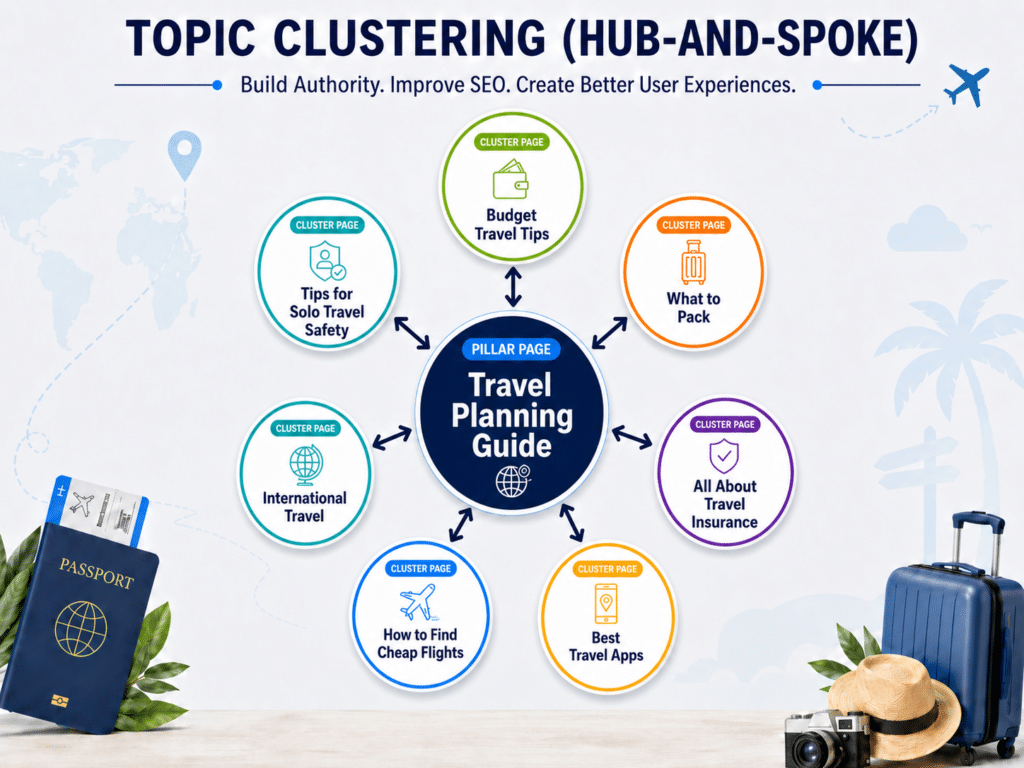
Sometimes referred to as the content hub-and-spoke model, a topic cluster strategy is made up of three central components:
- Pillar page: The hub page that houses the broad overview of the main topic;
- Cluster pages: The supporting pages (or “spokes”) that explore each subtopic in depth;
- Internal linking: Linking between the pillar and cluster pages that helps users navigate your site’s content and helps search engine crawlers understand the connection between pages.
Why Are Topic Clusters Important for SEO?
Search engines and LLMs want to provide users with the most relevant information. When your website comprehensively covers a topic and creates a logical site structure through internal linking, you are signaling to search engines that you know a lot about a topic. When the search engines discover that the content has value, they will likely agree.
When done right, topic clusters embody the E-E-A-T (experience, expertise, authoritativeness, and trustworthiness) qualities Google values by demonstrating depth of knowledge on a chosen topic while making it easy for users to find all relevant information for their queries in one convenient location.
The SEO and UX Benefits of Topic Clustering
- Builds Topical Authority: Covering a topic from multiple angles spanning the entire customer journey helps search engines and LLMs determine your expertise in your chosen topic. As the authority grows for your pillar page, that authority is spread to your cluster pages through internal linking.
- Expands Keyword Footprint: Because these pages cover themes instead of focusing on a single term, topic clusters naturally target related keywords, long-tailed keyword phrases, and other keyword variations.
- Improves Crawlability: The internal linking step reinforces the site architecture. When a main topic pillar links to a subtopic page with descriptive anchor text, it signals to search engines and LLMs how the two pieces of content are connected and which one best answers a specific query. When you do this enough, you develop a clear roadmap for search engines to crawl to better understand and index your site.
- Enhances User Experience: With a more intuitive site structure, users are able to easily navigate the site’s content, allowing them to find answers to related questions they may have on the topic without leaving your site.
- Improves Engagement Metrics: When your audience can easily find the content they need, they’re more likely to stay and explore additional pages. This has the potential to improve your engagement metrics like time on site, pages per session, and bounce rate.
How to Plan Topic Clusters
You can’t have a successful topic cluster strategy without research at its foundation. It’s a process that requires a lot of work up front, but the SEO payoff is worth the effort. To get started with creating your first topic cluster, follow these steps:
- Choose Your Topic: Start with seed keywords and identify a broad topic that aligns with your business. This becomes the foundation (or pillar) of your topic cluster. For example, a travel blog could choose to focus on the broad topic of “Travel Planning,” creating an ultimate guide as the hub page.
- Select Your Subtopics: Expand your seed list into a keyword universe to identify all of the related subtopics. Tools like Semrush, Ahrefs, Answer the Public, Also Asked, and Google’s autocomplete suggestions can help find additional opportunities and content gaps. To establish expertise, an ultimate travel planning guide could include subtopics like: “Budget Travel Tips,” “Tips for Solo Travel,” “What to Pack,” and “How to Find Cheap Flights,” each with its own comprehensive page that links to and from the main pillar page.
- Start with a Group of Pages: It’s best to create your main pillar page in tandem with a few of your cluster pages. Launching your pillar page with three to five cluster pages helps to establish content depth from the beginning.
- Implement Internal linking: Link to and from the pillar pages to each of the cluster pages using descriptive anchor text. Linking is, arguably, one of the most important pieces of the topic cluster strategy because linking is what makes it a cluster.
READ MORE: How to Build a Winning Topic Cluster
Common Mistakes and How to Avoid Them
- Content Bloat/Thin Content: The topic cluster strategy isn’t about the number of pages you create. It’s about the value of the content. Content bloat happens when a site creates thin, redundant content that doesn’t add any value. Avoid this by focusing on the mapped keywords in your universe. Make sure each page created addresses a specific user query while adding unique value.
- Keyword Cannibalization: The cannibalization happens when multiple pages on your site compete for the same keyword or set of keywords. To avoid this, it’s recommended to complete topical mapping before content creation. However, keyword cannibalization can be fixed either through content consolidation, where the content overlaps, or by reoptimizing one page to fit a different subtopic.
- Poor Internal Linking: Without the proper linking, topic clusters fail. Every cluster page must link back to the main pillar page using descriptive anchor text that contains the core keyword theme to establish the connection between the pillar and its cluster pages. The cluster pages should also link to other relevant cluster pages to further help search engines and LLMs understand how all of the content fits together.
- Siloing: Both siloing and topic clustering share the same basis — organizing content in a group and interlinking among the pages to establish authority and implement a cohesive site structure. The rigid rules in siloing, however, block the ability to link between different clusters to further establish connections with related concepts. Avoid this by linking related content, regardless of the cluster it belongs to.
As SEO evolves, the way we target keyword themes has had to evolve with it. Keyword research is still important to your content strategy, but modern SEO and GEO aren’t about targeting one word at a time on one page at a time. It’s about establishing your website as an all-around expert on the topics most prevalent in your industry.
If your current content strategy feels a bit disjointed, it may be time to shift your focus from ranking for one keyword at a time to owning topics within your industry. Websites that focus on building comprehensive, interconnected content plans will be in a better position to compete in both traditional search and the everchanging world of generative AI search.