

Websites usually have plenty of room for improvement. Ideas like rewriting the headline, shortening the form, adding trust signals, or redesigning the page are all viable ideas. But with limited time and budget, deciding what to act on is the bigger question.
Conversion Rate Optimization (“CRO”) provides a way to answer this with evidence. It connects what people experience on your website with the business results you want, then helps you decide what to change, how to evaluate it, and what to do next.
What Is CRO Really Trying to Improve?
At its core, this means increasing conversions, which for a service business could be an inquiry or appointment booking. And for an online retailer, it’s typically a purchase. The conversion rate, though, is only part of it.
A page might generate more inquiries, but it could also send sales a larger number of unqualified leads. A discount can boost purchases, but at the cost of lower profit. Having more customers doesn’t necessarily mean the business is healthier.

The key is asking the right questions to get to the right answers. Customers are struggling somewhere; what’s the cause? Which change would make the biggest difference? And what evidence would support putting more resources into it?
This relevance extends to marketing decisions that go beyond the website itself. Before boosting paid media spend, it’s crucial to assess whether the landing page effectively communicates the offer and allows visitors to take action smoothly. The campaign and post-click experience are closely intertwined.
How CRO Works in Practice
CRO begins with a specific business objective or a critical customer action. “Improve the website” or “Improve conversions” is too vague. “Enable users to complete a quote request” provides a clear objective to investigate.
It’s essential to start with determining what can be measured. A baseline needs to be established to ensure that the proper actions are properly targeted and tagged for reporting. Google Analytics relies on key events to report on specific actions, but it’s crucial that these events accurately reflect the intended outcome.
Once a baseline is established, we use data to start piecing together the story of the user journey through the site. Understanding how many users arrive at the site, where these users come in from, what they do after they arrive, and why they leave, combined with additional data points like recordings, usability, customer feedback, and sentiment analysis, determines where the friction points are.
A mobile form with a low completion rate may prompt you to consider shortening the number of fields. But is form length the root cause or a symptomatic solution? Analyzing user interactions may reveal that a required field asks for information that a user can’t provide or feels hesitant to share. It’s essential to discern the difference because the length of the form and the necessity of the information requested are two distinct problems that require different solutions.
One of the more common mistakes made is starting with a solution and backing into a problem. To address this, we turn findings into testable hypotheses. “If we make this required field optional because users can’t or won’t answer it, then we expect more quote requests to be completed.”
With time and budget being the typical constraints, prioritizing effectively is critical and based on three practical questions:
- Impact: Could this change materially improve my business objectives?
- Confidence: How strong is the evidence supporting the idea?
- Effort: What resources will it take to build, verify, and maintain the change?
A couple of small fixes supported with strong evidence may be a more effective option than a major redesign.
Now that you have identified which changes you want to make, how do you know if these changes actually deliver on the hypothesis? This is where A/B testing comes into the picture.
A/B Testing Is Just One Mechanism to Utilize
Simply put, A/B testing is a framework that allows you to test a change (or “variant”) against the existing condition (or “control”) in isolation of other variables. Without this, it becomes much more difficult to determine if a specific change is the reason for the outcome, be it positive or negative. The sample size needed to achieve a confident result depends on several factors, from existing conversion rates to the size and definition of success.
But not all changes need A/B testing. You don’t need to test a broken button to know it needs to be repaired. A low-traffic page may never produce statistically significant results.
Why the Business Outcome Matters
Here is a simplified illustration. A site receives 20,000 monthly visits, closes 10% of its leads, and averages $5,000 in revenue per sale. What could a 10% relative improvement in lead conversion mean?
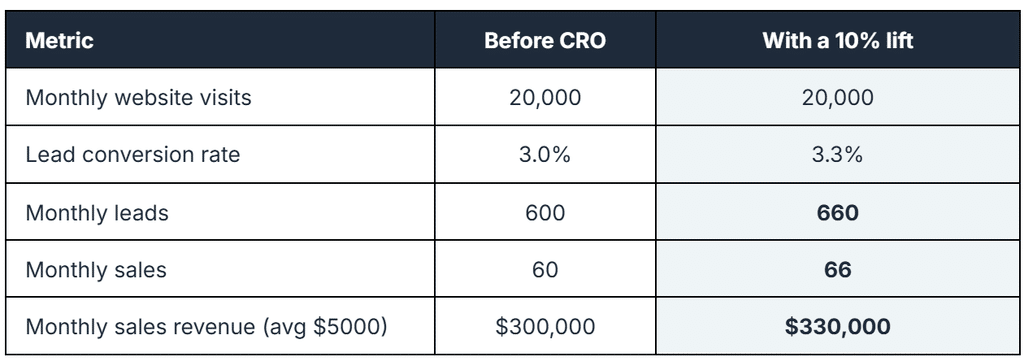
60 more leads and six more sales means $30,000 in extra revenue each month.
Moving from 3% to 3.3% is a 10% relative lift, or 0.3 percentage points. The numbers assume that traffic and lead quality, close rates, and sale values all remain consistent.
A monthly CRO investment is a significant cost, and it’s worth considering if the added revenue is enough to justify it.
Gains from a change can drive business value — revenue, quote requests, appointments scheduled — beyond the month it goes live, and future users can benefit from it too. This makes implementation, validation, and continued measurement a core part of the process.
Better Website Decisions Start with Evidence
CRO is what helps you decide where to invest in your website, and it gives you the evidence to support that decision.
Having a clear understanding of your customer needs, prioritizing the right changes, and the ability to measure their effect on business outcomes is where the value comes from. Start with a critical customer action, then verify the tracking of that task, investigate the behavior, and then determine a proper solution for the problem. Implement, observe, adjust, and repeat. There’s no silver bullet, but CRO is a proven process for driving meaningful outcomes.