

TL;DR
Google can demote a site’s rankings for using AI-generated content that violates Google’s Spam Guidelines. Using AI to create content for your website is a high-risk activity for SEO and GEO. Our case study demonstrates how just 31 AI-assisted blog posts crashed a site’s performance. JumpFly strongly recommends using AI strictly for research and outlining, not for content creation or even content polishing.
How AI-Generated Content Affects Organic Search
Officially, Google does not prohibit AI content from ranking in its search results. Instead, it values unique, high-quality, helpful content, regardless of how it is created. However, the Scaled Content Abuse spam policy mentions AI-generated content: “Using generative AI tools or other similar tools to generate many pages without adding value for users.”
Google also warns against using AI to create content in its guidelines for “creating helpful, reliable, people-first content.” “If you use automation, including AI-generation, to produce content for the primary purpose of manipulating search rankings, that’s a violation of our spam policies.”
In addition, Google’s Quality Rater Guidelines instruct its worldwide team of human quality raters on how to identify low-value AI-generated content, and that it should be given the “Lowest” quality rating. Google uses that data to train its algorithms to weed out low-quality and low-value-added AI-generated content from search results.

Jill details how Google’s quality rater guidelines affect its algorithmic systems in her blog post: Why AI-Generated Content Has an Even Shorter SEO Shelf Life Today.
Google and all of its competitors in search and AI are looking for the same thing: high-quality, helpful, unique content that demonstrates what Google calls E-E-A-T (experience, expertise, authoritativeness, and trustworthiness). The homogenized content that AI tools generate, even with sophisticated prompts or the AI suites baked into SEO platforms, does not produce the type of content search and AI systems are looking for.
Using AI to produce content without adding significant value invites an organic search performance crash in rankings, traffic, and leads or sales. It’s more than theory; our case study demonstrates the risk of posting even AI-assisted content on a site.
An AI-Assisted Content SEO Case Study
JumpFly’s client, EarthMed, strongly requested that we use the blog for their successful regional business as a test case for AI-assisted content. After strongly recommending that they not pursue this course, JumpFly SEO agreed to run a test to assess the impact of AI-assisted blog content on organic search performance. The following excerpts are from an analysis of the site’s performance after using AI-assisted content on the blog, and are shared with EarthMed’s permission.
First, what is AI-assisted content? For us, it is content generated using highly targeted, custom prompts to produce blog posts aligned with SEO guidelines, then heavily reworked for about 90 minutes by a true expert in the field. This was not the typical AI-generated “prompt and post” slop.
The first post went live in mid-July 2025. After that, a new AI-assisted blog post went live, on average, every nine days. As many as four new AI-assisted posts and four AI-rewritten posts went live in a single month.
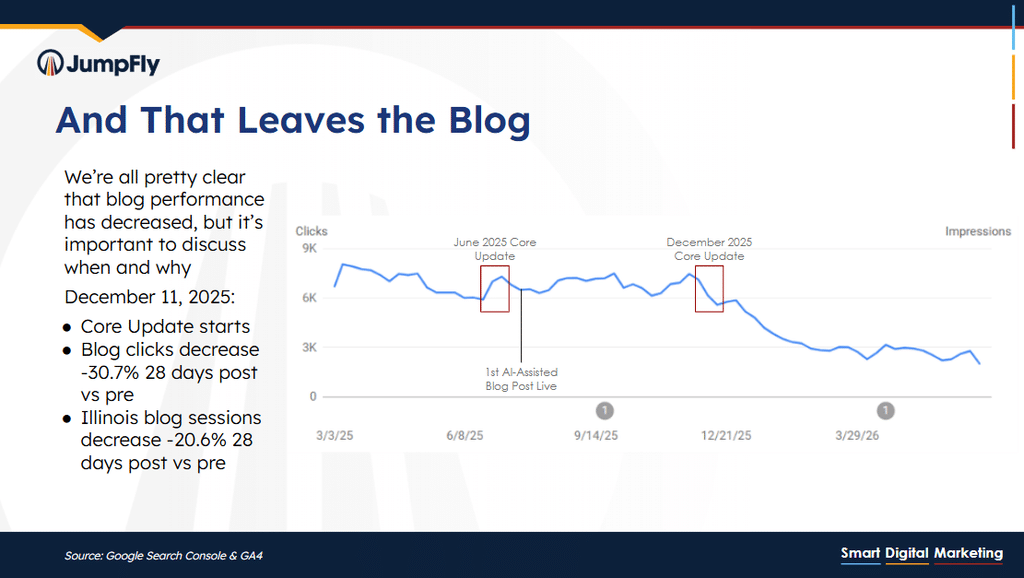
On December 11, 2025, when Google launched its December 2025 Core Update, Google organic search clicks for the blog dropped by 30.7% 28 days over the previous 28 days. No other SEO work or technical site events took place during that time so the test would be as clean as possible. In the slide below, note the correlation between Google’s core updates and the decreases in organic search clicks to the blog.
In addition, Google’s algorithm updates correlate with even larger decreases in impressions for blog content on Google Search, as shown below.
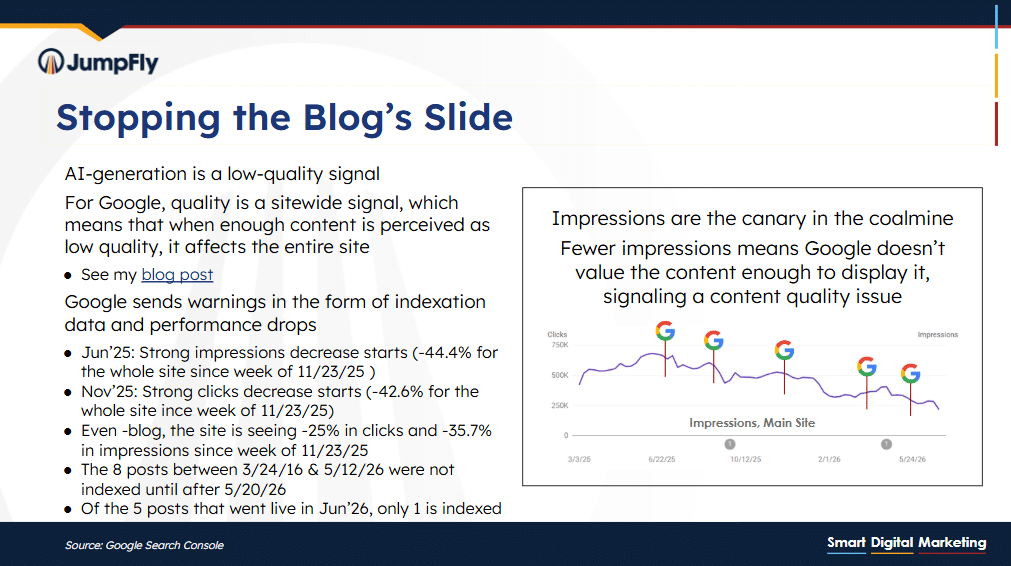
When impressions decrease this strongly, it’s a sign that Google doesn’t value the content enough to show it in search results. Another indicator that Google was not valuing the blog content was that the site’s indexation levels for blog content also decreased. In May 2026, Google had declined to index any of the last eight blog posts posted for over two months.
The performance decrease did not stop with the blog. The homepage lost 77.2% of its clicks YoY. The site even saw decreases in branded clicks to the homepage, as shown below.
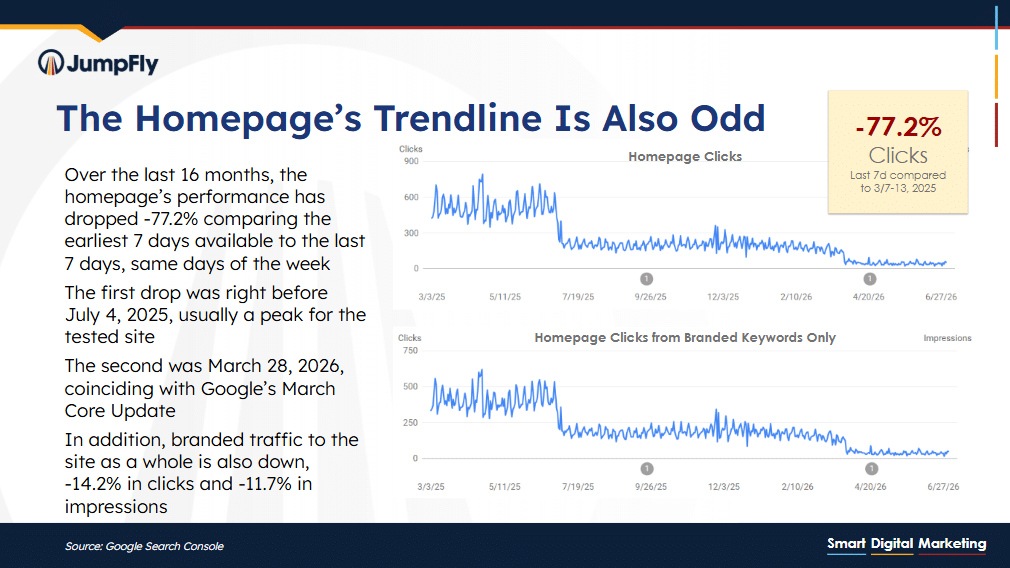
In addition, the entire site saw a significant YoY decline, indicating that using AI-assisted content on the blog can drag down performance across the entire site.
This is not a small site. It contains 35,000 indexed pages and boasts over 500 blog posts, written by hand by an industry expert until July 2025.
Still, the addition of 31 AI-assisted blog posts dramatically decreased organic search performance sitewide within five months. In October 2025, the blog drove 45.4% of the site’s 65,000 clicks, according to Google Search Console. Ten months later, in August 2026, the blog had lost 67.8% of its clicks and drove just 24% of the site’s traffic.
In reaction to this data, the business owner agreed to remove all AI-assisted blog posts from the site. We have returned to the original strategy of providing unique, high-quality, helpful content written by our expert. Now, we wait to see how long it takes to recover.
The Cost Is High and Lasts a Long Time
Overcoming a spam or other content-quality issue is a long, painful process that can take six to 18 months or longer. There are those who will tell you it’s a shorter process, but they’re not taking into account all of Google’s built-in delays that show them that the content won’t return to being spammed.
The recovery process looks like this:
- Day 0: Get hit by a Google core or spam algorithm update;
- Day 14: Determine what the causes could be with no information besides what you can glean from your own analytics and the actions taken on your site;
- Months 3-6: Fix the issue entirely;
- Months 7-9: Wait 90 days for Google to crawl and recrawl your site repeatedly to determine that the issue is gone and isn’t coming back;
- Months 10-15: Wait for another Google core or spam algorithm update to finish rolling out;
- Month 16: Determine if the fix improved performance; and
- Month 16.5: If not, try again.
The process is long, frustrating, and isn’t guaranteed to succeed. The site we used as our case study is in its second month of this process, and it still has a long road to travel.
How Much AI Is Too Much?
The problem is that no one knows how much AI-assisted or -generated content is too much. The site in the case study above shows that as few as 31 posts can produce strongly negative results.
We do know that AI-generated content is pretty easy to detect, both visually and with publicly available detection tools like Copyleaks, ZeroGPT, and GPTZero. If anyone can use freely available tools to test for AI-generated content, with varying degrees of success, think what Google can do with the might of its engineering team and budget.
We also know that Google announced two spam-fighting systems that target what their research papers call synthetic content, both textual and video: SAFE and S-CTS.
In addition, the EU requirements for watermarking AI-generated text will have a ripple effect on US-based tools like ChatGPT, Claude, Gemini, Copilot, and others.
When content is this easy to detect, it will also be easy to demote in organic search rankings and placements within AI platforms.
Summary
As tempting as it is to spin out easy AI-generated content for a blog, product descriptions, marketing copy, or anything else posted on your website, we strongly recommend resisting that temptation if organic search and AI visibility matter to your business. Even if you see a short-term gain, the stakes are too high, and the timeline for recovery is too long to be worth the risk in the end.