

Google Marketing Live introduced a lot of AI-driven updates this year, but one of the most important for ecommerce advertisers may be the Universal Commerce Protocol, or UCP.
UCP is Google’s open standard for agentic commerce. It was designed to help AI agents, shopping platforms (like Shopify), digital experiences (such as Google Search, Gemini, YouTube, and Shopping), merchants, and payment providers work together so shoppers can move from product discovery to purchase with less friction. Think of UCP as Google’s blueprint for letting AI agents buy things on our behalf—a searcher can “talk” to AI, learn about a product, and buy without ever leaving YouTube or AI Mode or Gemini.
For advertisers, this becomes more than just selling more products in a different way. It touches on the ecom platform, Google Merchant Center, and Google Ads, and links them more tightly than ever.
As shopping behavior becomes more conversational and more AI-assisted, the quality of your Merchant Center data and the way your products are connected to Google’s surfaces will matter even more. UCP is one of the clearest signals yet that Google is building toward a future where product discovery, product comparison, cart building and checkout can happen closer together across Search, Gemini, YouTube, Shopping, and other Google experiences.

What Universal Commerce Protocol Is
So first off, what exactly is the Universal Commerce Protocol? Universal Commerce Protocol is a commerce standard designed to support shopping experiences powered by AI agents. Instead of shoppers clicking through multiple steps, opening several tabs, researching products, adding items to the cart, and completing checkout entirely on a store’s website, UCP is meant to make it easier to make that journey happen from start to finish within a Google surface (like Google Search, Gemini or YouTube) or other surface (like Microsoft Copilot).
That doesn’t mean the merchant (the website) disappears from the transaction. One of the most important details for retailers is that the merchant remains the merchant of record, still owning the customer relationship, the transaction, and the post-purchase experience. This would be significantly different than the current state of marketplaces like Amazon or Walmart, where you lose out on that customer relationship and the all-important email.
Google has described UCP as a way to support commerce across the full shopping journey, including discovery, buying, and post-purchase support. From an advertiser’s perspective, that matters because Google Ads has always depended on intent. UCP gives Google more ways to turn that intent into action.
Why Advertisers Should Care
So why should advertisers care? Well, most ecommerce advertisers are already used to thinking about Google Ads and Google Merchant Center (GMC) together. Shopping and Performance Max campaigns, Demand Gen product feed ads, free listings, product annotations, promotions, shipping, returns, and product approvals all depend on Merchant Center data.
But UCP makes that connection even more important.
The traditional shopping journey often looks like this (though it usually looks more like a bowl of spaghetti, so this is very oversimplified, but you get what I’m trying to show):
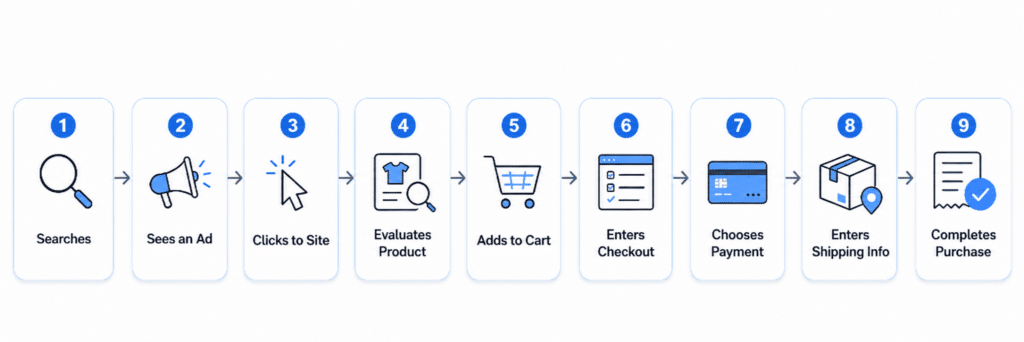
Every step creates the potential for drop-off, either from purchase friction, interruptions, or a slew of other reasons.
With UCP-powered experiences, Google is working towards a system where shoppers can discover products, add items to a cart, and check out faster on a Google surface using Google Pay and saved information in their Google Wallet. In some cases, shoppers may be able to check out directly within the Google experience, and in other cases, they might transfer the cart to the merchant’s website to complete it.
Think about it: seeing an item on YouTube and being able to order that item directly via YouTube, never having to go through a traditional website checkout process! Ah, shopping nirvana!
What that means for advertisers is that fewer steps between intent and purchase can change how users interact with ads, with feeds, with product listings, and most importantly, with checkout paths. Fewer points of friction or opportunities to get interrupted should mean more orders.
How UCP Changes the Google Ads/Merchant Center Relationship
From a Google Ads standpoint, UCP matters because Google has already said it is bringing UCP-powered features into ad campaign experiences.
Google specifically referenced UCP integration for brands using Direct Offers for Shopping Ads on YouTube with product feeds in Demand Gen campaigns at Google Marketing Live. That means UCP is not only about organic AI shopping experiences, but it is also beginning to connect with paid ads. For advertisers, that creates a few important implications.
First, product feed quality—always important to performance in Shopping and PMax—becomes even MORE central to performance. If the ad, product listing, AI answer, product comparison, cart, and checkout experience are all linked, then incomplete or outdated product data becomes a stopper to getting shown. Titles, descriptions, pricing, availability, promotions, shipping, returns, images, brand assets, and product attributes all need to be clean and current.
Second, advertising performance may become more closely tied to a merchant’s commerce infrastructure. Advertisers will still manage budgets, bidding, creative, audiences, goals, and asset strategy in Google Ads. But the ability to capitalize on UCP-powered buying experiences will depend heavily on what is happening in Google Merchant Center and how technically ready their website is.
Third, conversion friction may shift. Instead of optimizing to get users from an ad to the website, advertisers may need to think about how Google surfaces help users complete more of the purchase journey before they ever reach their website, or without ever going to the site at all!
That does not remove the need for a strong website. It does mean advertisers should be watching how UCP affects click behavior, conversion paths, cart behavior, and attribution once these features become more widely available.
Merchant Center Readiness Starts Now
From a GMC standpoint, Google is positioning Merchant Center as the central place to prepare product data for ads and listings across Google surfaces.
That’s not new, but UCP raises the stakes. The feed—as it’s always been—is your foundation.
Google’s GMC documentation says UCP-powered checkout can allow eligible product listings in AI Mode for Search and Gemini to display a checkout button. It also states that only product listings using the native_commerce product attribute will display the BUY button for this checkout experience.
This is a major technical detail. Advertisers cannot treat UCP as something optional, or that lives only in Google Ads. Readiness starts in GMC and with the merchant’s product data.
Google’s onboarding documentation says the GMC integration is rolling out gradually in the US, Australia, and Canada. To participate, merchants must complete the technical implementation, submit an interest form, be selected, and then use the onboarding process in GMC when it becomes available.
That onboarding process may include sandbox validation for the UCP profile, identity linking, and native checkout APIs. Merchant Center may also alert merchants to required updates to feed attributes, returns, and account configuration.
Conversational Attributes: The New Feed Layer
One of the most interesting updates is Google’s guidance around conversational attributes.
Conversational attributes are new, optional attributes specifically created to provide richer context for AI-powered shopping experiences. Instead of stuffing more information into existing fields, they created six new dedicated attributes that can be added to product feeds to help AI systems better understand products and answer shoppers’ questions.
The new attributes are:
- Question and answer (question_answer): a list of FAQs regarding that product, like what it comes with, size, etc.
- Document link (document_link): link to a product manual, user guides, assembly instructions, product diagrams, etc, must be hosted onsite and a PDF file
- Related product (related_product): products that go with the product, like accessories, spare parts, or substitutes; example: ink for an inkjet printer
- Item group title (item_group_title): used in combination with the existing attribute item_group_id, assigned to products with multiple variants; example: a t-shirt in three colors and five sizes
- Variant_option (variant_option): used in combination with item_group_title and item_group_id to specify the variant options available; for example: the shirt color and size options for the t-shirt mentioned above
- Popularity rank (popularity_rank): indicates the percentage of popularity of the item versus the other items in your catalog; the higher the number, the more popular.
Google recommends they be added via Supplemental feeds, or by adding them to your primary data source or via Merchant API. I’ll also be interested to see if you’ll be able to edit a product directly in GMC and add the data at some point down the road. And I’m relieved to see that including them won’t impact the approval status of existing products, so they can be a work in progress.
Adding these attributes is important, because AI shopping behavior looks quite a bit different than traditional searches. Think “what is the best travel bag for a trip to Europe when I’m concerned about pickpockets, that’s not too heavy, and I can wear all the time?” versus “travel bag”.
That first query requires richer product understanding. The basic feed attributes like title, description, brand, GTIN, and product highlights still 100% matter and are the foundation of feed optimization. But these new conversational attributes are going to help give merchants more ways to provide context to AI systems.
For advertisers, this is going to take a big change in thinking about the products as they get added to the catalog and require an overhaul of existing products. The better Google understands the product, the better the chance the product has to be considered in AI-assisted shopping experiences.
How Advertisers Should Prepare
UCP is still rolling out, and not every merchant will have immediate access. But advertisers and ecommerce teams should not wait until the feature is available to start preparing.
The first step is to audit Merchant Center for the basics:
- Product titles should be accurate, descriptive, and aligned with how shoppers search.
- Descriptions should include meaningful product details, not just boilerplate copy from the manufacturer that’s the same as anyone else’s.
- Prices and availability should be accurate and updated frequently—at minimum daily, but even multiple times a day depending on how volatile stock and pricing changes are.
- Product images should meet Google’s requirements, represent that product clearly, and offer multiple images—different views, lifestyle images, etc, not just one product image.
- Shipping and return settings should be complete and competitive (Merchant Center has changed the returns section, and many that I’ve checked have been incorrect).
- Promotions and loyalty or member pricing, if applicable, should be structured correctly.
If your Merchant Center setup is already weak, UCP will not fix it—it will amplify it.
The second step is to talk with your ecommerce and development teams. UCP is not only a media feature. It requires technical implementation. If a retailer uses a third-party ecommerce platform, payment provider, or feed management tool, they should ask what the provider’s UCP roadmap looks like.
For Shopify merchants, this becomes much easier, as Shopify is one of the core companies behind UCP, not just a downstream platform adopting it. Shopify’s role may make agentic commerce more accessible to Shopify stores over time, but advertisers should still treat Merchant Center as the operational checkpoint for Google eligibility, feed quality, UCP onboarding, and product-level readiness. (See my blog specifically for Shopify merchants.)
The third step is to review whether your product catalog is ready for more conversational discovery. That means adding in product detail attributes, product highlights, structured variant data, FAQs, related products, and supporting documentation that will become more useful as Google expands AI-driven shopping.
The fourth step is to watch Google Ads placements and reporting closely as UCP-powered experiences expand. Advertisers should pay close attention to Demand Gen campaigns with product feeds, YouTube Shopping placements, promotions, Direct Offers, and any new reporting that Google may (hopefully) come out with.
The fifth step is to prepare your internal stakeholders or clients for a changing checkout journey, as more ecommerce activity may happen less on your website and more on Google surfaces. That could be good for your conversion rate, but it will require a change in interpreting traffic, sessions, cart activity, and purchases.
The Bigger Picture
UCP is reinforcing a wider trend: Google is turning product data into performance infrastructure.
In the past, some advertisers would sometimes treat Merchant Center as a necessary setup step for Shopping campaigns, but once done, they didn’t look at it again. Upload the feed, connect it to Google Ads, maybe check for disapprovals, and move on. Treating shopping feeds like a one-time deal invariably leads to my favorite line that a Googler ever uttered in feed training—“crap in, crap out”—when talking about why the feed and data cleanliness matters. Having properly optimized titles matters (did you know that if you have multiple products with an identical title, only one will show in results at a time? Yep! Can’t tell you how many feeds I’ve audited with identical titles and clients asking why they don’t show up for more results.)
Data is only becoming MORE important (I’ll have to come up with a new favorite line). For modern ecommerce advertising, Merchant Center is part of the optimization engine more than ever. It influences eligibility, visibility, product understanding, ad quality, automated campaign performance, AI shopping experiences, and now potentially checkout functionality.
As UCP expands, the strongest advertisers will likely be the ones that combine media strategy with feed strategy, technical readiness, conversion path analysis, and merchandising expertise.
This is especially important for Performance Max and Demand Gen campaigns, where Google’s systems depend heavily on product data, assets, audience signals, and conversion goals. If Google is using AI to match products to more complex shopping journeys, then advertisers need to give AI better inputs.
Universal Commerce Protocol is not just another Google announcement. It is a sign—a huge blinking red sign—of where ecommerce is headed.
Google wants to make shopping more frictionless and more conversational. For advertisers, that means ads, product feeds, AI recommendations, carts, and checkouts are all one big ball of importantness.
Brands that prepare now—I mean right now—will be in a better position as these features roll out. That preparation starts with Google Merchant Center and making sure that the data is strong and clean, adding thoughtful data enrichment with the new attributes, technical readiness for your website, and a Google Ads strategy that accounts for a more AI-driven shopping experience.
UCP may be early, but we’ve got our directions—the future of Google Shopping is not just about showing the right product to the right user. It will be about giving the right signals to AI to show your ads to the right shopper, and helping the user take action faster, with fewer barriers between discovery and purchase.