

When Keywords Ruled PPC
If you’ve been in PPC as long as I have (nearly 20 years, but who’s counting?), you remember when everything in your account revolved around keywords and tightly structured ad groups. Exact match was exact. Phrase match meant Phrase match, and Broad match was something you used only when you were feeling brave.
You know what? It worked.
That Model Doesn’t Hold Up Anymore
Well, it’s 2026, and PPC just doesn’t work like that anymore, and hasn’t for a while, really. Today, success isn’t about the words people are typing; it’s about who they are, what their intent is, whether they’re ready to take action, or simply doom searching.
We’ve moved from optimizing for keywords to optimizing for people.

Why?
I have to state the obvious reason here. People matter! The whole goal of advertising on a search platform is to help people, giving them the answers they are looking for, and quickly. Gone are the days when someone would search for something on Google, see a few suggested ads, and choose one from that list and complete a purchase. People aren’t just changing; their search style is changing. Expectations are changing.
The “Messy Middle” of Modern Search
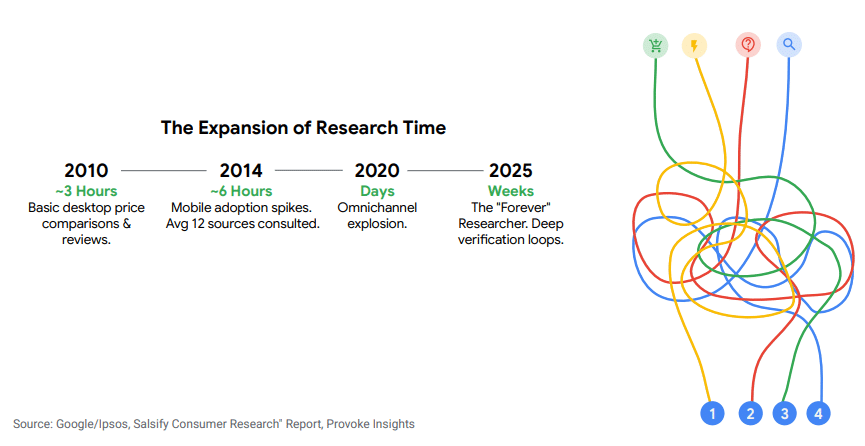
I was on a recent Google Webinar regarding AI Max for Search, and they called this the “Messy Middle.” Per a Google/Ipsos study, people spent around three hours researching in 2010; that doubled to six hours in 2014. 2020 was days of research, and with 2025, it’s now weeks of research. And the way they are searching has changed, too.
How AI Changed Search Behavior
With the incorporation of AI in search, people are much more conversational when they are looking for something. In the past, you might have typed in “restaurants near me” to find somewhere local to go eat. Now, you’re typing things like “do any Thai restaurants near me have gluten-free options?” If you type that and get a list of restaurants without any callout to being gluten-free or Thai, will you be clicking? The answer is likely to be no.
The addition of AI may be a big one, but it isn’t the only thing that has changed in the world of PPC.
Match types don’t exactly “match.” Automation is getting smarter. Smart bidding is practically impossible to ignore. Performance Max showed up and yelled “Shotgun!” and then decided to sit in the driver’s seat. Suddenly, platforms aren’t just matching queries. They’re evaluating intent, behavior, context, and a whole lot of other signals that we’ll (probably) never see.
The Old Mindset vs. the New One
Old mindset: Target the right keywords, and you’ll reach the right users.
New mindset (for now😅): Understand the right users, and you’ll reach them, even when their searches look like they were typed by their cat.
Why Letting Go of Control Is Worth It
Yes, this shift feels uncomfortable at first, especially if you love control (same!). It is actually better, though, and I honestly never thought I’d say that. We reach relevant users earlier, spend less time babysitting match types and keywords, and spend more time on real strategy: messaging, landing pages, and the quality of conversions.
We run accounts using automation where it makes sense, applying human strategy where it helps most, and focusing on what actually drives results, not just what satisfies our inner spreadsheet goblin (which, for the record, I absolutely have!).
Keywords aren’t dead. They’re just not the main character anymore. Modern PPC isn’t about forcing keyword variations. It’s about understanding the human behind the search and building smarter strategies around that.
What to Focus on Now
Don’t wait to start shifting your PPC mindset. There are things you can do now. Stop stressing over every keyword and focus on the following:
- Know your audience: Target the people who matter, not just everyone who clicks.
- Keep an eye on automation: Smart bidding and Performance Max work best when you guide them.
- Make your messaging count: Ads and landing pages should actually connect with people. Put yourself in the user’s seat.
- Measure what matters: Conversions over clicks, quality over quantity.
Your inner spreadsheet goblin might protest, but it’ll live. (Promise!)