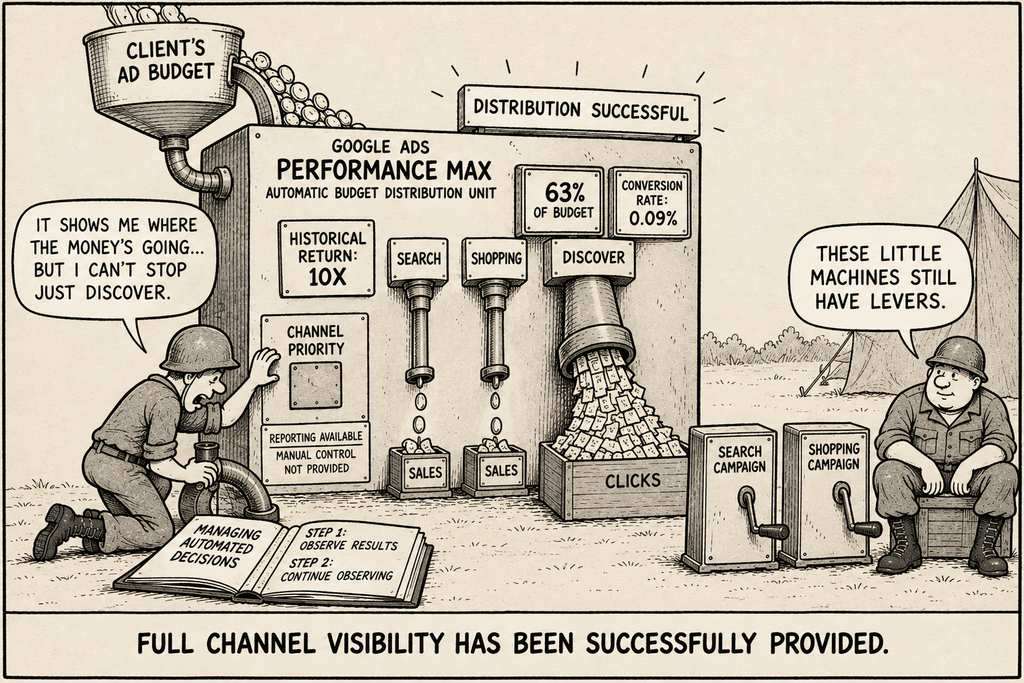

I’m not writing this to complain. I’m writing this because I feel betrayed. I had a wonderfully efficient account regularly returning a 10x ROAS for my client.
In October 2026, that all changed.
A few days after Amazon’s Prime Big Deal Days, performance softened. Because of the conversion delay, I wasn’t immediately concerned. Impressions were strong, clicks were looking good, so I expected the conversion numbers to catch up as usual.
They didn’t.

I opened the Channel performance report and gasped. Their Performance Max campaigns had sneakily shifted the majority of their budgets away from the highly profitable Search and Shopping inventory toward Google Discover.
Where’s the Problem? The Numbers Speak for Themselves
Our historical Search and Shopping performance within those campaigns had conversion rates around 3%, acquisition costs were near $27, and the ROAS hovered around 10x for months.
In October, the numbers changed. Discover charged us the super-low click cost of $0.10 with an impressive 8.89% click-through rate. Wow, that’s impressive engagement, on the surface.
Unfortunately, those cheap clicks led to a dismal 0.09% conversion rate, a $113 CPA, and a collapsed ROAS.
Account-wide, Discover’s share of the daily budget shifted from approximately 20% to 63% over the course of seven days. That means the campaign was spending far less on the much higher-converting Search and Shopping inventory that had driven so much success.
This was not just poor performance on the Discover network, but a major shift in inventory paired with deteriorating overall results.
Here’s why I’m so frustrated: we know that Performance Max optimizes against the overall campaign ROAS goal and can allocate budget to any channel if the algorithm predicts a greater return there.
Fine. That theory checks out.
But why was Performance Max continuing to pour my client’s money into Discover when the actual conversion performance was so much worse?
In my search for an answer, I investigated every change we made to the account, including keyword exclusions and changes to budgets and creative assets. Nothing we had done provided an explanation for the pattern we observed across all four campaigns.
And before you ask, Google’s new channel-prioritization controls won’t solve this particular problem. Search, Discover, YouTube, Gmail, and Maps are bundled together as “Google channels.” We still cannot independently prioritize Search over Discover or establish a Discover-specific budget limit within Performance Max.
This leaves advertisers with a potentially serious problem.
With my client’s Black Friday promotions scheduled to begin in November, we don’t have the luxury of waiting for the algorithm to re-optimize Performance Max.
So, instead of speculating about why this shift in channel distribution happened, let’s focus on what we can control. We’ll look at how to identify a dangerous shift in channel distribution, contain the damage, and build a Discover-proof advertising strategy.
Four Steps to Protect High-Intent Traffic From Performance Max Budget Shifts
Step One: Watch Channel Distribution Instead of Relying on the Campaign ROAS
The first thing you need to do is pay careful attention to the Channel performance tab located in the Insights and reports tab. From here, you can see an overview of where all of your Performance Max campaigns are spending.
Compare the last seven days with the preceding period, looking specifically at Discover’s percentage of spend, the dollars spent, conversions, conversion value, and ROAS. While you’re at it, double-check YouTube, Display, and any other channels that appear to be overpowering Search. Unfortunately, my colleagues have seen YouTube and Display take over just as quickly as Discover did in my client’s account.
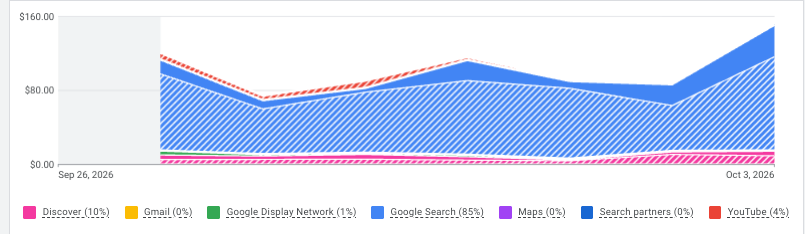
If you select an individual campaign, you can see a chart that illustrates the spend.
Here’s what it should look like in one campaign:
And here’s what the shift in spend looks like in that same campaign:
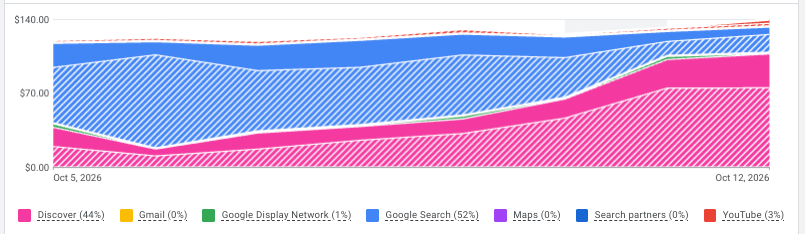
In this campaign alone, Discover spend went from 10% to 44% in a matter of days, averaging out to 63% across all four. These cheap clicks should not be mistaken for success, even if they contribute to a rising CTR. Neither pays the client’s bills.
Step Two: Don’t Panic, Investigate
First, check to see if any of that Discover spend is converting. If it is, and those conversions are contributing to a strong ROAS, then your campaign is fine. But if you see numbers like I did (thousands of clicks, hardly any conversions, and a tanking ROAS), you’ll need to address it.
Check the campaign’s change history for changes to budgets, ROAS targets, conversion goals, or creative assets.
Then, review the balance: is Discover actually spending more, or has Search spending declined?
Remember, Google’s algorithm considers factors we cannot fully observe.
Step Three: Contain the Damage
If Discover has eclipsed Search and Shopping, should you pause your Performance Max campaigns? Possibly. But I recommend temporarily cutting the budget down to a fraction of its normal budget while you build new campaigns to take over. When I did this, the campaigns immediately stopped spending on Discover, and what small budget was left began to serve on the Search and Shopping networks. The volume was dramatically reduced, but we stopped the bleed.
Some online sources recommend removing the assets that allow the campaign to serve on Discover. However, this does not guarantee exclusive Search and Shopping delivery. Instead, the immediate goal is to limit the amount of money the campaign can spend while preserving its ability to serve (somewhat).
Step Four: Protect High-Intent Traffic
While the Performance Max campaigns were starved of the extra funds that the algorithm-driven Discover budget provided, I got down to business.
First, I built Standard Shopping campaigns to cover the products we were advertising in those Performance Max campaigns. Standard Shopping allows advertisers to more directly manage inventory selection and campaign budget distribution. Luckily, the AI Max for Shopping feature had rolled out for this client. I enabled that, loaded up Text Guidelines, and enabled URL Expansion.
Then, my team and I built dedicated Search campaigns to protect valuable keywords and capture proven purchase intent. We enabled AI Max on those campaigns as well. The benefit here is that eligible exact-match keywords are prioritized over Performance Max when they match the user’s query. This gives us much greater control over the most critical searches.
Within days, the new campaigns began bringing in conversions, admittedly below the client’s target ROAS, but this is to be expected as new campaigns ramp up.
I chose this hybrid strategy specifically to support proven demand while preventing spend on Discover. Search and Shopping campaigns are not eligible to serve on that network!
If you find some level of Discover prospecting valuable to your business, you can test it separately using a Demand Gen campaign. This campaign type allows you to manually select some channels, and it keeps your budget dedicated to this upper-funnel intent without sacrificing the budget you want to spend on proven purchase intent.
Visibility Without Control Is Not Enough
I’m not entirely abandoning Performance Max. It can produce incredible returns when the algorithm’s decisions are aligned with my client’s goals.
Crucially, however, historical performance is no guarantee that it will continue, as I saw in this account.
Although we may never know exactly why Discover began spending so aggressively here, what I do know is that advertisers cannot afford to confuse multi-channel automation with guaranteed profitability.
So please, monitor channel distribution carefully. Investigate unexpected shifts in budget allotment across those channels. Protect valuable traffic using the campaign types that offer the most control.
Because apparently, Performance Max has discovered it can spend aggressively on Discover… And it’s having a wonderful time doing it.
Our job is to make sure our clients aren’t paying for that enthusiasm.