

If your SEO content strategy feels scattered, your website probably does, too. Publishing blog posts one by one without a broader plan can make it harder for search engines to understand what your site is really about. That is where topic clusters come in. A topic cluster is a group of related pages built around one central subject. Done well, topic clusters can strengthen site structure, improve internal linking, and support topical authority. They also make your content easier for users to navigate, which matters just as much.
What Is a Topic Cluster?
At its simplest, a topic cluster is a content framework: Start with a core topic that matters to your audience and your business. This topic should be based on keyword research, and there should be sub-topics with search volume around it that are relevant and available to target.
Once that’s done, build one main page that broadly covers that topic. That page becomes the pillar page, targeting the biggest, core search term of the topic. Around it, create supporting pages that address related subtopics in greater detail. Each of those pages links back to the pillar, and the pillar links out to them, creating a web of similar yet unique topics that encourages clicking and reading through multiple pages.
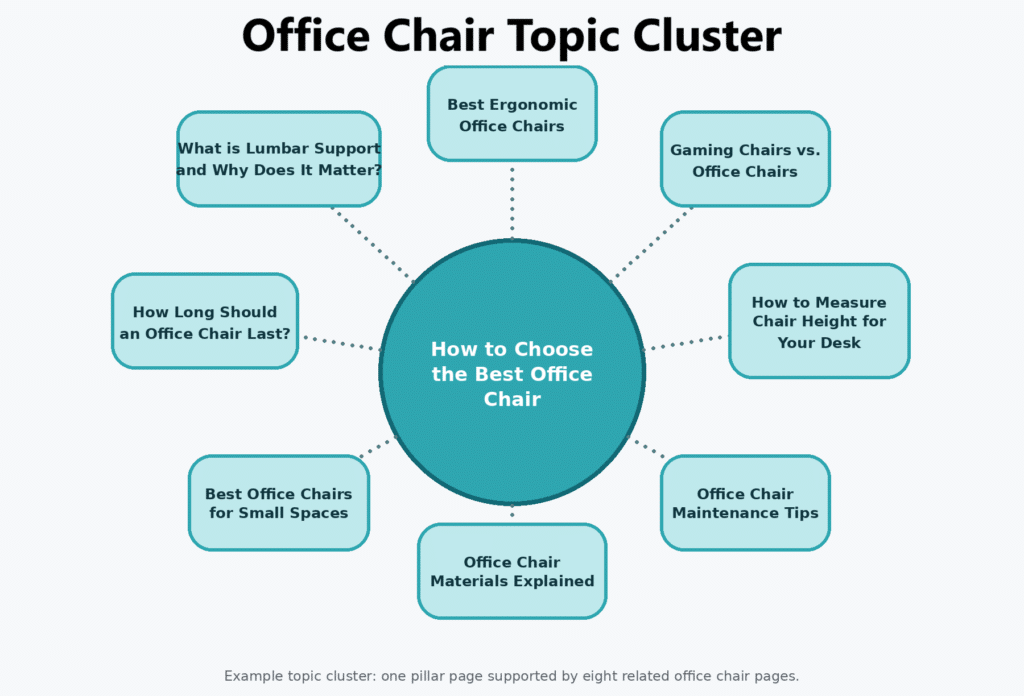
For example, if your site sells home office furniture, your core topic might be office chairs. Your pillar page could be a guide, like, How to Choose the Best Office Chair. Supporting cluster pages could include:

- Best Ergonomic Office Chairs
- Gaming Chairs vs. Office Chairs
- How to Measure Chair Height for Your Desk
- Office Chair Maintenance Tips
- Office Chair Materials Explained
Each of the pages supports the main topic while targeting different search intents. Together, they help search engines understand that your site covers office chairs thoroughly and intentionally.
Why Topic Clusters Matter for SEO
Topic clusters help SEO because they create context. When your site has a strong cluster of related content, it sends clearer signals about your expertise on a given subject. Instead of seeing one isolated article, search engines see a network of pages that work together to cover a topic from multiple angles. This helps build topical authority and, if written thoughtfully and aimed toward the consumer, can satiate Google’s desire for helpful content.
This structure also helps solve a common content problem: creating articles that overlap, compete, or drift too far off-topic. Having a cluster strategy forces you to think about hierarchy, intent, and internal linking before you publish, which often leads to stronger pages and fewer random content decisions.
Topic Clusters Are Not the Same as a Content Pile
This distinction is important because a new site can have a lot of content about one subject without having a real topic cluster. A content pile is an unorganized mix of content. If the pages are not structured well, do not link strategically, or overlap too much, they may not help each other much at all, and instead add bulk to the site.
A topic cluster is deliberate, built around a clear central idea, and each page has a defined role within the larger structure. That is good news if you already have a large content library because you may not need to start from scratch. Sometimes the better move is to run an SEO content audit on what you already have, identify overlap, choose a pillar, and reorganize existing content into a more intentional cluster.
Start with the Right Core Topic
A winning topic cluster starts with a topic that is broad enough to support multiple pages, but focused enough to stay coherent. It’s incredibly important to stay within the bounds of your brand. Too often, websites publish content that strays too far from their core business, which can confuse both readers and search engines about what the site truly knows best. For example, if your site sells home office furniture, an article about kitchen remodeling ideas likely wouldn’t be relevant enough to strengthen that cluster. Your core topic should sit at the intersection of three things:
- What your audience is searching for
- What your business actually sells or understands
- What you can realistically build authority around
In addition to irrelevant content, some brands choose topics that are too broad to compete on, while others choose topics that are too narrow to support a meaningful cluster. For e-commerce brands, a strong topic cluster often starts with a core product category. A skincare brand, for example, might build a cluster around vitamin C serum. A footwear retailer might focus on running shoes for flat feet. Distinct topics can naturally lead to supporting or product-focused pages, FAQs, and other opportunities to expand or repurpose content.
Build the Pillar Page First
Your pillar page should provide a broad, useful overview of the main topic. It is not meant to answer every question in full detail. Instead, it should introduce the topic, touch on major subthemes, and create natural opportunities to link to deeper pages. Think of it as the hub, not the entire map. A strong pillar page should:
- Answer foundational questions clearly
- Include logical subheaders for major subtopics
- Link naturally to supporting pages
- Prove useful if a visitor never clicks deeper
- Target a broad, relevant keyword theme
For an e-commerce example, let’s go back to office chairs: A pillar page like How to Choose the Best Office Chair could include sections on ergonomics, lumbar support, seat materials, chair dimensions, and use cases. From there, each section can link to a more focused cluster page, as well as products. That way, the pillar page helps users get the full picture while the supporting pages answer narrower questions in more depth. The cluster creates a comprehensive resource for everything a reader needs to know (without leaving your site).
Create Supporting Cluster Pages Next
Cluster pages are where you go deeper into the details. These pages typically target more specific queries, subtopics, or user concerns related to the pillar topic. They may answer common questions, compare options, explain features, or help shoppers make a decision. Using the office chair example again, supporting cluster pages might also include: Best Office Chairs for Small Spaces, How Long Should an Office Chair Last?, and What is Lumbar Support and Why Does It Matter?
Each page should stand on its own, but it should also fit naturally into the bigger structure. This is also where e-commerce brands can get especially strategic. Not every cluster page has to be a blog post. That flexibility is part of what makes topic clusters so useful. Some of the strongest supporting pages may be:
- Buying guides
- Category pages with expanded copy
- FAQs
- Glossary-style educational pages
- Infographics
- Product comparison pages
Internal Linking Is the Key to Making the Cluster Work
Without internal links, you do not really have a topic cluster. You just have related content sitting near each other. The pillar page should link to the cluster pages, and the cluster pages should link back to the pillar whenever it makes sense. In many cases, supporting pages can also link to one another. Interlinking helps search engines understand the relationship between the pages while enabling users to move naturally through the topic. The key is to keep those links relevant and helpful. A topic cluster should feel guided, not forced. Anchor text matters here, too. Instead of generic phrases like ‘Learn More’ or ‘Click Here,’ use descriptive language that clearly signals what the linked page is about, using exact match keywords when logical.
How to Know If Your Topic Cluster Is Working
Topic clusters are not one-and-done, but frameworks you refine as your site grows. A topic cluster should do more than look organized in a content calendar. Over time, it should help improve:
- Crawlability and content discovery
- Engagement on supporting pages
- Internal traffic between pages
- Rankings for primary and related keywords
- Visibility across a broader set of search terms
A strong topic cluster can also reveal content gaps. If one cluster page performs especially well, that may point to related topics worth expanding. If multiple pages are targeting the same intent, you may need to consolidate them.
Build a Winning Topic Cluster
If your SEO content strategy feels disconnected, a topic cluster can bring structure to the chaos. It helps search engines better understand your site, helps users find related content more easily, and enables your team to create pages with more purpose. Instead of publishing random content and hoping it ranks, you are taking the time to build a foundation that supports authority, usability, and visibility together. Start with strategy, stay consistent, and the gains often compound.